


RAF (PAF) FaldingworTh
In March 1944, 300 Squadron moved with their Wellingtons from RAF Ingham to RAF Faldingworth and were quickly converted to Lancasters.
Volunteers from RAF Ingham Polish Bomber Squadrons Centre are responsible for maintaining the RAF Faldingworth Memorial.
-
Losses
Faldingworth Memorial
(Click on the menu items above)

FALDINGWORTH AIRFIELD
Commemorating Polish Air Force 300 Squadron
Faldingworth Airfield lies around 2 miles West of the A46, near the village of Newtoft, some 13 miles North East of Lincoln.
The layout was that of a Class ‘A’ standard and opened in October 1943 as part of Bomber Command 1 Group.

RAF (PAF) Faldingworth was initially used as a ‘decoy airfield’ for RAF Hemswell known as Toft Grange and later as a satellite airfield of RAF Lindholme then, late 1943 for RAF Ludford Magna.
In July 1943, ‘1667 Heavy Conversion Unit’ (HCU), based themselves here, training crews to operate heavier-duty 4 engined bombers, predominantly the Avro Lancaster and Handley Page Halifaxes.
In March 1944, Polish 300 (Masovian or Mazowiecki) Squadron relocated from RAF Ingham, some 7 miles to the West, where they had been based for just under 2 years. They moved initially with their 2 engine Wellingtons, to be quickly converted to the 4 engined Lancasters, Ingham being a grass (Class A) runway and unable to accommodate the weight of the considerably heavier Avro Lancaster bomber.
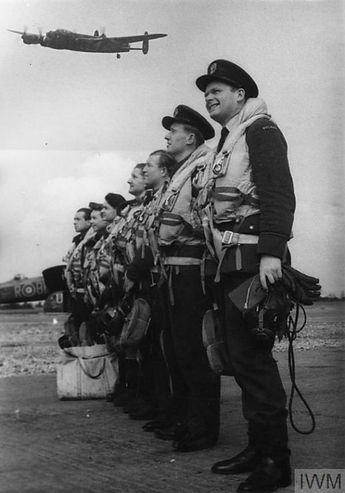
Officer Jerzy Rózanski (foreground) and his crew of No. 300 Polish Bomber Squadron standing in line at RAF Faldingworth, early June 1944.
The crew perished during the bombing sortie over Gelsenkirchen shortly after this picture was taken, on 12/13 June 1944.
Note, a Lancaster bomber flying over the airfield and another one parked in the background (ED327, BH-R – lost in August 1944).


300 Squadron (Masovian)
300 Polish Bomber Squadron was created on 1 July 1940 as the first Polish unit at RAF Bramcote (Warwickshire), as part of the Polish Air Forces in Great Britain. It then moved on the 22nd August 1940 to RAF Swinderby before relocating to RAF Hemswell on 18th July 1940. 300 Sqn was stationed at RAF Ingham from 18th May 1942 to 1st March 1944 (with another short spell at Hemswell during this time), before its final move to RAF Faldingworth. On 29th January 1945 , RAF Faldingworth was officially handed over to the Polish Air Force (PAF), becoming PAF Station Faldingworth.
From
1 July 1940
22 August 1940
18 July 1941
18 May 1942
31 January 1943
22 June 1943
1 March 1944
Deployment History
300 (Masovian) Squadron was a Polish bomber squadron formed in Great Britain as part of an agreement between the Polish government-in-exile and the United Kingdom in 1940.
Squadron code: BH (July 1940 – October 1946)
Disbandment: 1947
Base
RAF Bramcote
RAF Swinderby
RAF Hemswell
RAF Ingham
RAF Hemswell
RAF Ingham
RAF Faldingworth
Missions and Losses
Between 19 July 1940 and 8 May 1945, the crews of 300 squadron flew 3,891 sorties and spent 20,264 hours in the air.
During these missions, the Polish 300 Squadron lost 79 aircraft, 371 airmen were killed and 87 were captured. 104 of these losses are commemorated on the Memorial at RAF Ingham Heritage Centre along with 57 airmen from RAF 199 squadron. 44 of 300 Sqn crew are buried in the Netherlands.
After the war, 300 Unit handed over its aircraft to the RAF on 11 October 1946 and was disbanded on 2 January 1947.

FALDINGWORTH AIRFIELD MEMORIAL
On the eastern end of the East-to-West Faldingworth runway is a memorial to lost crews, predominantly 300 squadron.
The memorial is open to the public on selected days of the year, or by appointment, please call 07842 845491 for details.

Total Losses from Faldingworth: (28/09/1943 to 09/06/1946) are 242 flight crew.
300 Sqn: 208 lost (04/03/1944 to 09/06/46)
1667 Heavy Conversion Unit (HCU): 31 losses (28/09/1943 to 23/01/1944)
1546 Flt: 3 losses (08/01/1945) – Crash N York Moors
The Memorial commemorates specifically 10 of those 300 Squadron plane losses and 2 HCU flights, who’s plane remains or artifacts from their crash sites are placed within the Memorial.
But of course, it really commemorates all who lost their lives (or were injured physically or psychologically) as a results of departure from RAF (PAF) Faldingworth.
The base is constructed from concrete blocks broken from the old runway, perimeter track, aircraft standings and buildings; these represent the broken lives and tragedy of war. Out of the base rise three columns of stone. These represent Lincoln Cathedral, known by many aviators as a landmark. It also represents hope for future peace rising out of the destruction of war; BUT WE ARE NOT THERE YET, which is why two sides of each stone are still rough.
Inside the base there are placed small parts from some of the aircraft of 300 Sq'n & 1667 Heavy Conversion Unit (HCU) lost from Faldingworth. In the case of DG358 no parts of this aircraft were available, so part of an oak tree with some Welsh soil from the crash site are buried in the memorial.
The parts of 300 Sq'n aircraft are buried with some soil from the Masovia area in Poland. The squadron was called the Masovian Squadron.
The crew names are on the adjacent notice board and HERE.
The crews will probably have taken off for the last time on the runway where this memorial stands, it being the main East/West runway.

Faldingworth Church
Faldingworth, North Lincolnshire
Faldingwith Church contains a memorial and recognition of Polish 300 Masovian Squadron and the links and close relationships between the RAF and the Polish Air Force (PAF).

what3words location - ///lecturing.humans.thrashed

The Church entrance pathway.
As you approach the church outer gates look down at the path. On the right or East (the direction of Poland), red and white edging bricks. On the left or West, representing Britain are the red, white and blue bricks.

The Gateway and its symbolism
The design of the gates shows the RAF and PAF (Polish Air Force) markings with the letters ‘BH’, call sign letter for 300 Squadron. Above this the impression of the runway.
The arms sweep out from different parts of the world, Poland and Britain, to join in prayer as they pass through the door (depicted in the gates) into the next existence.
Wings carry one skyward for those who returned, with a half wing either side of the door for those who did not.
Funding:
The project was supported by many contributors through donations and grants, including a bequest from Diane Power in memory of her parents Beryl and Henryk Jachaz and other polish airmen who flew from the airfield. Her father flew from Faldingworth and, like so many, had been a PoW in the USSR and later shot down to become a PoW in Germany.
The gates were dedicated on Saturday 8th October 2005. The dedication was attended by: Bishop Suffragan of Grimsby, Father Grzegorz Czaja, RC priest for Lincoln and Scunthorpe, Rev. Liz Smith, Methodist Minister and Revd. Charles Oatrick, Rector of Faldingworth.

The impressive North Aisle commemorative window
‘Two crosses stand central in the main panels. The one on the right (Poland lies to the East), representing the Christian community of Poland, the one on the left of Great Britain. The ribbon flows back and forth around the Polish and British crosses representing the coming together of two peoples. The rose and cornflower represent the people coming from their own country’s earth and of love found and lost. Poland did not have a national flower, however when the airmen were asked which flower represented Poland they told me they remembered the cornflower in the field when they left Poland.
The flowers position near the cross represents the great sacrifices made. Above all is the sunburst symbolising the fact that we are all one people under the sun. There is some sharpness in the shape of the sunburst, depicting the pain and suffering, not only of those long gone from this life, but also of those who were left behind.’
(Author of this text unknown)
Lower down in the window panels, there is the Polish Air Force chequerboard and the Royal Air Force roundel representing the Polish and British airmen and women. The famous Polish words ‘For our and your freedom’ in English and Polish are on the ribbon, wrapping the two peoples together.
The glass is in parts transparent and so allows the landscape and the sky to be seen, thus showing that the love and friendships fought for and forged in the past are also for today. As we look beyond, we should carry the examples of the past into the future. Let their sacrifices be an inspiration for the next generation.
Polskie Siły Powietrzne – Polish Air Forces Plaque
(North wall to right of commemorative window)
Transcribed from a previous account, author unknown.
‘From 1944 to 1947, the Airfield at Faldingworth was a Polish base and home to 300 Bomber Squadron. It was unusual in being designated P.A.F. for part of the time in 1945 and not RAF. To remind future generations how people can come together in adversity and of the sacrifices made, a plaque was installed in the Church on 29th April 1995. The previous day a Lancaster bomber flew over the village as a tribute to the Poles. On the 29th, Poles came from all over Britain and even an aircrew member from Canada. The Queen’s colour of the Central Flying School was paraded followed by PAFA and RAFA standards.
The plaque was carried into church by Gregory Prochnicki, whose grandfather and grandmother endured hardships we pray may never happen again.
On the plaque the words ‘ZA NASZA I WASZA WOLNOSC (For our and your freedom).’